

Yesterday
Southwestern University Unveils Artwork Chosen to Anchor Southwestern University 560 Development
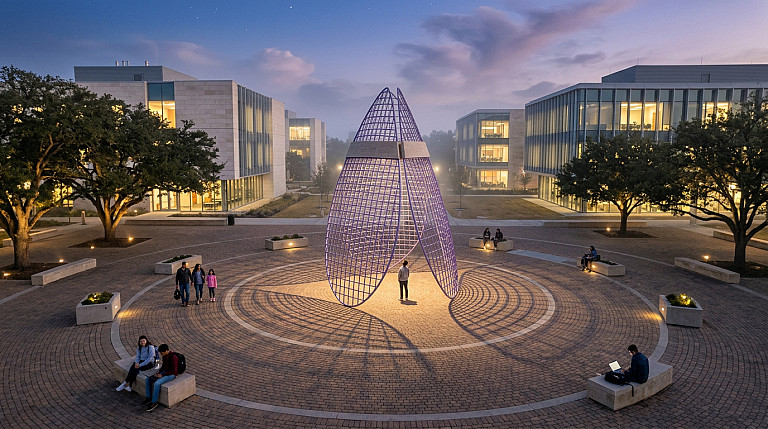
The identity of the Southwestern University 560 (SU 560) development project continues to come into focus. Southwestern University is excited to unveil Rio Grande Valley artist Sarita Westrup’s piece Nopal Sanctuary as the signature, landmark artwork that will welcome visitors to one of the nation’s most ambitious university-led mixed-use developments.
Nopal Sanctuary consists of three purple metal lattice forms resembling nopal, the edible flat pads of prickly pear cactus, one of the most recognizable plants of the Texas Blackland Prairie where SU 560 calls home. The pads lean inward, relying on each other for structural integrity, a design Westrup says is a physical metaphor for community reliance, resilience, and shared strength.
The work is designed to be surrounded by limestone paving and benches to create a gathering space. Visitors can physically step inside the artwork, moving from the openness of the surrounding area to an intimate, high-walled sanctuary that frames an uninterrupted view of the Texas sky overhead.
A contemporary basketmaker, Westrup plans to construct Nopal Sanctuary out of heavy-gauge, weather-resistant structural aluminum. The woven piece will be finished in custom powder-coated tones inspired by natural cochineal dyes, radiant tones of carmine, pink, and purple harvested from insects that feed on native nopal.
“Translating my studio basketry practice into monumental aluminum has allowed me to scale hand-weaving into an enduring public architecture,” Westrup said. “Inspired by nopal cactus pads, the sculpture honors the rich Mexican and Mexican-American cultural history of Texas and its ecology, while creating a welcoming sanctuary for everyone to step inside, gather, seek shelter from the sun, and look to the Texas sky.”
Westrup has strong ties to Central Texas. Although she was raised in McAllen, she spent many holidays visiting her grandparents, who settled in Austin in the 1980s after immigrating to Texas from Mexico City. She credits her Mexican-American family for teaching her to love art, storytelling, and the iconography that connects identity to place.
Throughout her career, Westrup has exhibited work at institutions such as El Museo del Barrio and the Chautauqua Institution in New York and the Penland Gallery in North Carolina. She has presented solo exhibitions at the Erin Cluley Gallery in Dallas and at Arts Fort Worth. Nopal Sanctuary marks Westrup’s first career public art commission.
“Receiving my first public art commission with Nopal Sanctuary is a major milestone in my career, but on a personal level, it’s a deeply meaningful homecoming,” she said. “With my grandmother living just 20 minutes from the SU 560 Art Park, this project represents my largest love letter yet to Texas and my roots as a child of Mexican immigrants.”
Westrup’s proposal was unanimously selected by SU 560’s Public Art Council, a team of nationally and internationally recognized leaders in curating, cultural strategy, philanthropy, design, business, and higher education. The Council sought artist submissions for pieces that honor the history and cultural heritage of Central Texas, acknowledge the Native peoples who first lived on this land, reflect the beauty of the Texas Hill Country, and embody Southwestern’s liberal arts and sciences mission.
“This work belongs in this landscape,” Southwestern University President and SU 560 Public Art Council Member Laura Skandera Trombley said. “It offers exactly the kind of learning SU 560 should make possible: students exploring art, cultural history, ecology, and engineering through a single work.”
SU 560’s Public Art Council is led by Arizona State University Art Museum Director Miki Garcia, as well as internationally recognized cultural strategist András Szántó. Along with their fellow Council members, Garcia and Szántó oversaw the selection process, meeting with 15 artists from around the world over several months. Four finalists were chosen to participate in site visits of the Southwestern University campus and SU 560 development site, as well as in person interviews with members of the Council.
“After a deeply researched and collaborative selection process, Southwestern University has invited Sarita Westrup to create a new work for this sensitive and symbolic site, literally on the front door of the campus,” Szántó said. “It is only fitting that the process led us to an artist with deep personal and cultural ties to the site, and someone who embodies the promise of an emerging generation.”
Nopal Sanctuary will not only define the identity of SU 560, it will also serve as the anchor of the development’s future Art Park, a space envisioned to inspire discovery, connection, and creativity.
“I am thrilled that Sarita Westrup has been chosen to create the first landmark public sculpture for the Art Park as part of the new SU 560 development,” Southwestern University Associate Professor of Art and SU 560 Public Art Council Member Ron Geibel said. “Westrup’s work brings the knowledge and traditions of basketry into contemporary sculpture, connecting the handmade to the landscape and cultural histories of Texas and offering opportunities for students, faculty, and staff to connect art with their own experiences and areas of study. I look forward to seeing how their work invites gathering, sparks conversation, and becomes part of the everyday life of the Southwestern community.”
SU 560 was designed to weave art throughout the entire development. From the Art Park at the district’s entrance to public art integrated throughout the development, SU 560 is poised to become a cultural destination unlike any other in Central Texas.
Nopal Sanctuary is expected to be completed in 2028. As design work progresses, Westrup will collaborate with the project’s landscape architects to refine its placement, surrounding native plantings, and gathering spaces.
Construction on SU 560 is officially underway. The site’s first building, the City of Georgetown’s new Customer Service Center, is expected to open in mid-2028 as the anchor of the first phase of development. Encompassing 67 acres, the first phase will create an active, walkable district with a strong sense of place and a diverse mix of uses. Planned features include 110,000 square feet of office and research space, 45,000 square feet of retail, 150 multifamily homes, a 110,000-square-foot hotel and conference center, a 38,000-square-foot entertainment venue, and 35 acres of parks and open space.